My wife and I visited Florence and the Chianti-Tuscany region, focusing on art and architecture, restaurants and wineries. Scroll down or click on links to the right for photos.
This article was orginally published in the Greensboro, NC News and Record: "Tastes of Tuscany." Go to http://www.news-record.com/enews. You'll have to create a login, but it's free and you can use it in the future. Publication date: June 19, 2011. (When you log in, you'll get the current day's paper. If you are reading this after June 19, click on the Search tab, enter the article title, and set the drop down menu to "All issues.") The article appears on pages H6-H5.
The tour was arranged by La Dolce Vita Wine Tours (http://www.dolcetours.com/). I plan to host trips to Italy again next spring. If you think you might like to go with my group, please write to me directly, john.e.batchelor@gmail.com. You don't have to travel with me, but please tell La Dolce Vita that I sent you! They make trips regularly, and Pat and Claudio are knowledgeable, personable travel guides. Go to their website to see various locations they offer.
Tastes of Tuscany
Article and photography by John Batchelor
Tuscany is undergoing a transformation. Stone villages, constructed in the Medieval era, are being rebuilt as townhomes. Tourism has become an essential element of the economy. Significant changes in wine production are underway as well. The combination of history, scenery, traditional Italian food and wines, and restaurant dining all add up to a great travel opportunity.
Florence is home to great collections of Renaissance art. Two galleries are major. Uffizi houses paintings, including Botticelli’s Venus. Galleria Accademia specializes in sculpture; Michelangelo’s David is the star. Long waits can be avoided with online reservations (www.uffizi.com). Better yet, use a service (www.viator.com, for example). We not only went the head of the line, we gained narration from a well-informed guide.
The dome (photo 01 Duomo) of Basilica di Santa Maria del Fiore is Florence’s best known architectural feature. Construction began in the 13th Century. On the Ponte Vecchio bridge (photo 02 Ponte Vecchio), shops have been selling jewelry for centuries.
Two wine bars merit attention: Cantinetta Antinori (www.cantinetta-antinori.com) and Frescobaldi Wine Bar (www.deifrescobaldi.it/en); they serve great, casual food.
Our trip focused on wineries and food, in addition to art and architecture. We visited two wineries each day, interviewing winemakers and tasting the result of their blend of art and science .
A tour of wineries in Chianti is an exploration of a new generation’s efforts to restore what previous generations lost. After WWII, most Italian wine became cheap and weak-flavored, sold in bottles wrapped in baskets. The new generation refers to these by the term “fiasco” (“basket” in Italian), which carries a negative connotation from English.
In order to promote improved quality, Italian consortia have developed three wine classifications: IGT (grapes grown in a specific region); DOC (from a particular region, restricting production to intensify flavor, and limiting blending); and DOCG (following the strictest regulations). Look for these when buying Italian wine.
At Vecchie Terre di Montefili winery (part constructed in the 13th Century), the DOCG turned out to be the best Chianti I’ve ever tasted. It is a Chianti Classico, another label feature worth noting, meaning all grapes were grown in the original Chianti region.
We had dinner one night at La Bottega, operating 300 years from a stone building with a terrace overlooking the town of Volpaia. We passed platters, family-style: baked eggplant with mint and garlic, dressed in olive oil and balsamic vinegar; fresh pasta with spinach, ricotta cheese, butter and sage; sliced pancetta, pepperoni, and prosciutto, made in-house; white beans and sausages simmered in tomato sauce; chicken stewed with onions; and boar stewed with olives. This is traditional Tuscan fare- slow cooked, tender meats with rich flavors. Every item was priced below 10 euro- strong value.
Brolio Castle (photo 03 Brolio Castle), owned by the Ricasoli family, houses a private museum collection of arms and armor dating to the 13th Century. Ricasoli winery hosted another tasting. Castello di Brolio (90% sangiovese, 10% cabernet sauvignon), made a very positive impression.
Castello di Meleto (www.castellomeleto.it/) (photo 04 Meleto Castle) is about 1,000 years old. It operates as a hotel/B&B, winery, and olive oil production facility. It houses a theater (photo 05 Meleto Castle theater), one of about a dozen built inside a castle. We had a cooking lesson here- making fresh pasta by hand- tutored by the castle’s cook and grandmother of our dinner waitress, who grew up in the castle.
Several wine bars in Montalcino provide tastings of over 100 Brunellos. Brunello is a wine from a particular sangiovese clone, usually associated with the area around the towns of Montalcino or Montepulciano. My favorite was Ciacci Piccolomini di Aragona. A photo (photo 06 View from Ciacci Piccolomini di Aragona) from the vineyards illustrates the panoramic beauty of the Tuscan countryside.
We also got a taste of Italian driving here. A cab driver evidently did not understand a passenger say that he was getting out. She started away, knocking him over. As he struggled to get back up, she looked down and cussed him out. If he had been injured, I’m pretty sure she would have just backed over him. One word of advice about driving in Italy: don’t.
The Abbey of Saint Antimo (photo 07 Abbey of Saint Antimo) provided peace, as we attended the monks’ mid-day prayers/chants. These rituals have been observed in this location for centuries.
Montepulciano. At Poliziano Winery (www.carlettipoliziano.com), in addition to sangioveses we liked, we encountered Le Stanze, an exceptional blend. Meticulous production begins with picking and destemming grapes by hand. The quality movement was supported by another family in this region, the Marianis, owners of Banfi wines. They made a fortune from Riunite (one of the cheapos), then bought properties in Brunello, funding research that led to improved sangiovese clones. They made the best ones available to all wineries.
I have been in situations where games about wine knowledge develop, and that’s not fun (especially if I’m losing). Our group included two wine professionals who were preparing for advanced exams, but their pleasant personalities contributed positively to the experience. We also shared the trip with two Australians, and we came to appreciate their wit. After one of the wine educators asked about a production detail, our host translated the winemaker’s explanation, a lengthy, technical process. One of the Aussies remarked, pointing to a machine, “But he didn’t tell us what that knob does!”
We overnighted in Rome to make return connections, joining about a million other tourists walking along the Spanish Steps (photo 08 Spanish Steps) and the Trevi Fountain (photo 09 Trevi Fountain). Overhearing English, we asked directions. That led to, “Where are you from?” “Greensboro, North Carolina,” came the reply. Their names were Nancy and Elizabeth Fletcher, a mother and daughter who has been attending school in Rome two years. “Really liked your column about Marisol,” remarked Mrs. Fletcher.
Sunday, June 19, 2011


Photos from Chianti


Photos from Florence area


Sunday, November 21, 2010



Thursday, November 11, 2010
A Week in Provence
Getting There. My wife and I took US Airways, which offers convenient connections from Greensboro through both Charlotte and Philadelphia to Charles de Gaulle airport (CDG), outside Paris Atlanta
Travelling in France Avignon
Driving in France US
Finding a Place to Stay. The French Ministry of Tourism grades hotels on a scale of 1 to 4 stars. As a point of reference, the full service Marriotts at CDG and Port de Cap d'Ail (adjacent to Monaco) are rated 4 stars. In Provence, the Best Western chain has a strong presence, and all the ones I checked were rated 3 stars. A 2 star hotel is probably similar to an American bed and breakfast inn (although it is unlikely that breakfast will be included in the price), and at 1 star, some facilities (such as bathrooms) are likely to be shared among guests.
Finding a Place to Stay. The French Ministry of Tourism grades hotels on a scale of 1 to 4 stars. As a point of reference, the full service Marriotts at CDG and Port de Cap d'Ail (adjacent to Monaco) are rated 4 stars. In Provence, the Best Western chain has a strong presence, and all the ones I checked were rated 3 stars. A 2 star hotel is probably similar to an American bed and breakfast inn (although it is unlikely that breakfast will be included in the price), and at 1 star, some facilities (such as bathrooms) are likely to be shared among guests.
Selecting an American chain undermines the French experience, substituting standardization with familiar features. You may prefer the individuality and quirkiness that characterizes real French hotels. A word of caution: no matter where you stay in Provence
Practical suggestions: Buy a 220 to 110 volt converter (at Radio Shack, for example) before you go. That way you can use your laptop and charge your cell phone. If you want to stay in touch, most cell service providers sell global cell phones, which cost no more than domestic devices. Also consider taking a small coffee maker. Few hotels provide American style coffee. Their espresso preparations yield small portions, which cost $5-$7 per cup. Even if you buy a coffee maker in France France
Eating. A widely held stereotype exalts French cooking. The perception is justified, but only if you know how and where to find good food. Most serious restaurants do not open for dinner until 7:30, and prices can be quite high. If you want to eat earlier or at less expense, brasseries are open all afternoon, and they provide special ambience with outdoor seating. [Photo 01. Lunch in Aix en Provence] In these, however, I often found canned green beans, canned corn, frozen French fries, and farm-raised, low quality Atlantic salmon. Red meats tend to be tough, although the flavor is good. Chicken often tastes better than in the US
Getting Information. Consult the Michelin red guide red for restaurants and hotels, the Michelin green guide for travel sites. I have found guides from Eyewitness Travel and Rick Steves helpful as well. Most towns have tourist centers, where personnel usually speak English.
My wife and I began our most recent trip inAvignon (population approximately 90,000), situated on the Rhone River
My wife and I began our most recent trip in
Pont du Gard, an aqueduct constructed by the Romans approximately 2,000 years ago is situated a short distance from Avignon Nimes France when it was part of the Roman Empire ). Vieux Moulin Pont du Gard (www.vieuxmoulinpontdugard.com), a hotel and restaurant, is located on the banks of the Le Gardon River. [Photo 05. Vieux Moulin Pont du Gard] Lunch here was delightful, and I have never dined anywhere else amidst such classic scenery.
I think Nimes France
I am enchanted by Medieval cities. Le Beaux was carved into a mountain in the 10th century. [Photo 08. Le Baux Fortress] This fortress-town is replete with hidden entries leading to a maze of killing zones to thwart invaders. Shops and restaurants line the narrow, stone streets today. Near Provence
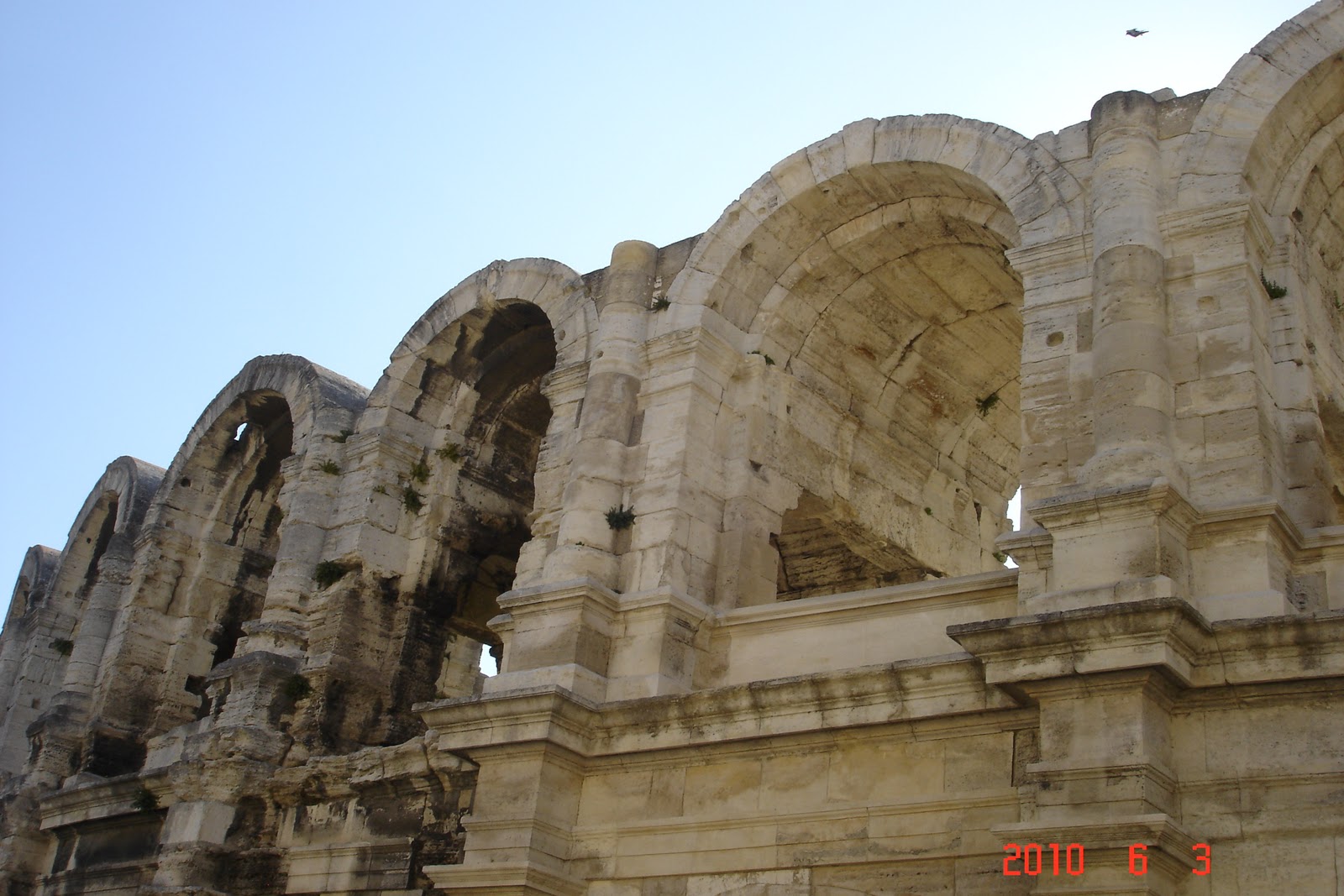
The accompanying photo of the arena in Arles Arles
We found several very good, moderately priced restaurants in Arles
In the ancientvillage of Glanum , dating from the 7th to the 4th Century B.C., the Romans built an arch to celebrate the conquest of Gaul by Caesar Augustus around 10 B.C. [Photo 10. Arch at Glanum] The arch, along with an even older mausoleum, stand in a field off a country road outside St. Remy (population approximately 10,000), where we had our most enjoyable lunch at La Terrasse au Soleil (1 Blvd. Victor Hugo, 04.95.55.97). In spite of its relatively small size, the downtown section with classic buildings is lively and quite a pleasant place to visit.
In the ancient
Reflections on this Trip. The age and beauty of Provence
My wife and I took this trip with relatives who have lived in France
I would consider using a travel service under normal circumstances. People who have local knowledge and contacts and can provide English-speaking guides and reliable transportation are invaluable. I would definitely go back to France Provence
I am organizing another trip to this area based on the hotels and restaurants mentioned above, along with others of similar interest, which may include cooking classes. We are also looking at cruises to several destinations in Europe , with a focus on wine and fine dining, including winery tours. Winery excursions to California , Oregon , and Washington
John Batchelor is a free lance writer who has been reviewing restaurants and narrating occasional travels for 30 years. Send e-mail to john.e.batchelor@gmail.com.
Subscribe to:
Posts (Atom)